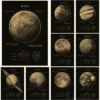
Scaling the Solar System’s Tallest Volcanic Peak
Towering into the rust-hued Martian sky, Olympus Mons dominates the horizon, dwarfing even Earth’s tallest peaks. This towering volcanic mountain rises 16 miles high – nearly three times taller than Mount Everest.
With a width of 374 miles, Olympus Mons also claims the title of largest volcano in the solar system. Its massive footprint stretches wider than the entire state of Arizona. This shield volcano’s gently sloping profile resembles an ancient warrior’s battle shield – hence its fitting name meaning “Mount Olympus” in Latin.
While summiting Mount Everest is the ultimate human climbing achievement, the much larger Olympus Mons remains the true pinnacle yet to be conquered. Understanding how this alien colossus grew so enormous reveals the hidden forces sculpting the red planet’s surface.
Birth of a Volcanic Giant
Olympus Mons began forming billions of years ago, long before Earth’s continents drifted into shape. Located in Mars’ Tharsis region, it emerged over a “hot spot” – an upwelling of molten material from the planet’s mantle.
On Earth, such hot spots spawn chains of volcanoes like Hawaii as the crust inches above them. But Mars lacks moving tectonic plates. Its stationary crust allowed Olympus Mons to remain over a hot spot and keep growing for eons.
While typical volcanoes have violent, explosive eruptions, shield volcanoes like Olympus Mons ooze lava that flows more gently. Its slow-moving lava spread widely before cooling, piling up hundreds of individual flows over time to form the gently sloping shield profile.
With less surface gravity than Earth, lava flowed even farther on ancient Mars. Combined with high eruption rates, layers of lava flows built Olympus Mons up 6 miles higher than the limit possible on Earth.
Over billions of years, the ongoing eruptions constructed a volcano nearly triple the height and size of anything on our planet. Olympus Mons just kept growing, thanks to Mars’ static surface allowing a hot spot to keep pumping lava to one location.
An Ever-Changing Alien Landmark
Although Olympus Mons stopped erupting eons ago, it remains the largest topographic feature on Mars. Spacecraft in orbit continue revealing new complexities about this shield volcano’s structure and history.
In the 1970s, NASA’s Viking orbiters found that unlike volcanoes on Earth, Olympus Mons lacked large cinder cones and lava channels. This supported the theory that erosion scoured away such features over billions of years. Later missions confirmed recent activity – lava apparently flowed just 2 million years ago in geologic time.
Perched at the summit lies an enormous crater 50 miles wide – perfect for hosting several Mount Everests within its basin. Formed by collapsed magma chambers under the surface, this caldera contains six overlapping craters from separate collapse events throughout Olympus Mons’ long history.
Exploring an Alien Volcanic World
From fresh impact craters to possible cave skylights, Mars continues revealing its dynamic nature through spacecraft eyes. Up close study of Olympus Mons and other volcanoes holds keys to understanding the red planet’s evolution.
Future missions may even collect samples proving if the mountain’s volcanic history matches current theory. And perhaps one day, astronauts will peer down from Olympus Mons’ dizzying summit into the vast Martian plains below – the greatest volcanic view in the solar system.