Before TV dramas or social media, early America buzzed over one influential tastemaker renowned for his continental flair. Long before Michelin stars or the Food Network made chefs famous, Thomas Jefferson won widespread fame for his epicurean adventures. Though not truly ice cream’s importer as myth claims, the forward-thinking Founding Father still helped the exotic frozen dessert enchant the early Republic.
A Pioneering American Foodie is Born
Thomas Jefferson’s renown as an ardent food enthusiast emerged early in his lifetime. Born into Virginia planter aristocracy in 1743, his elite upbringing cultivated an appetite for fine cuisine and drink. During political posts in America and abroad, Jefferson gained access to global gastronomy. He relished new dishes and wrote detailed commentary on vintages that stocked his esteemed wine cellar.
From French Cuisine to American Classic
But few experiences influenced Jefferson’s epicurean expertise as profoundly as serving as U.S. Minister to France between 1784-1789. Immersion in Parisian dining as revolution simmered let Jefferson refine his culinary prowess. He acquired an enduring taste for continental trends like ice cream, which began appearing in French cookbooks starting in the late 1600s.
So when Jefferson later imported a freezer and molds to his Virginia estate, ice creamcraft became standard entertainment at lavish parties hosted by the Francophile Founding Father. He enjoyed creating decadent riffs combining frozen custard and flaky warm pastry. Even during his demanding presidency, White House guests delighted in Jefferson’s hospitality as much as his ice cream.
Taking Ice Cream Mainstream
While not truly introducing the novelty dessert to America as myth claims, Jefferson almost certainly expanded ice cream’s early prominence through his fame and entertaining. As America’s premier political food influencer, his appetites sparked public intrigue. Local newspapers even shared reports of the exotic frozen delicacies gracing the President’s sophisticated table.
Within decades, ice cream recipe permeated cookbooks and everyday fare outside upper echelons, seeding a national infatuation. Technological improvements expanded access further, until the treat we now celebrate as an all-American classic took hold coast-to-coast.
Today heirloom homesteads like Jefferson’s Monticello charm visitors with restored ice cream preparation methods linking us to gourmand days of yore. But it was forward-looking tastemakers like the Presidential Francophile who first opened America’s eyes to ice cream’s enduring magic. Thanks in part to Jefferson the bon vivant, the rest is culinary history.
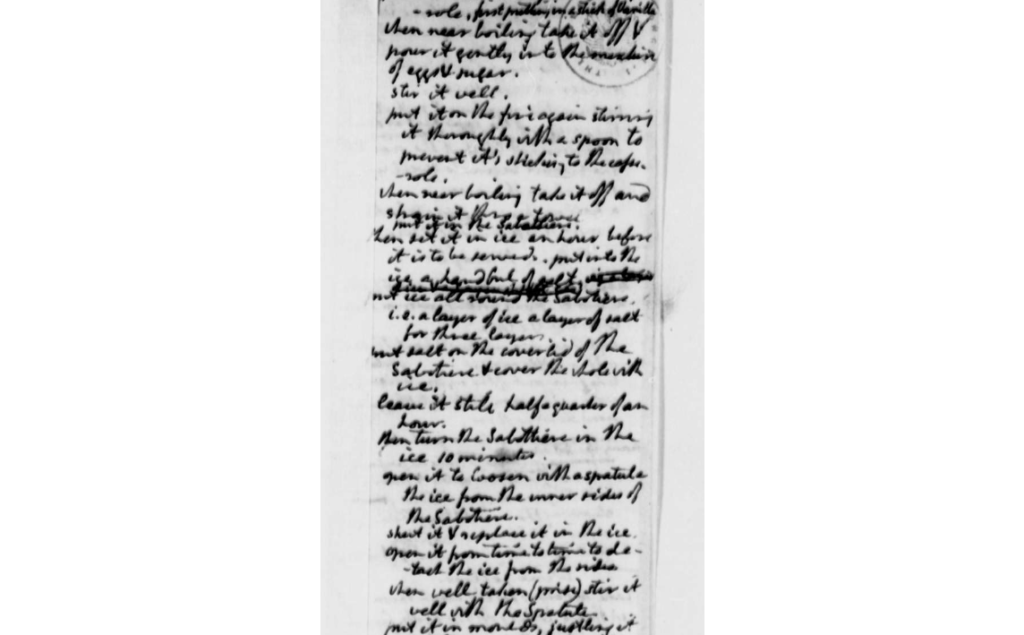
You can try Thomas Jefferson’s Ice Cream recipe yourself below:
Thomas Jefferson’s Ice Cream Recipe (source)
Ingredients
- 2 bottles of good cream
- 6 yolks of eggs
- 1/2 lb. sugar
Recipe
- mix the yolks & sugar
- put the cream on a fire in a casserole, first putting in a stick of Vanilla.
- when near boiling take it off & pour it gently into the mixture of eggs & sugar.
- stir it well.
- put it on the fire again stirring it thoroughly with a spoon to prevent it’s sticking to the casserole.
- when near boiling take it off and strain it thro’ a towel.
- put it in the Sabottiere
- then set it in ice an hour before it is to be served. put into the ice a handful of salt.
- put salt on the coverlid of the Sabotiere & cover the whole with ice.
- leave it still half a quarter of an hour.
- then turn the Sabottiere in the ice 10 minutes
- open it to loosen with a spatula the ice from the inner sides of the Sabotiere.
- shut it & replace it in the ice
- open it from time to time to detach the ice from the sides
- when well taken (prise) stir it well with the Spatula.
- put it in moulds, justling it well down on the knee.
- then put the mould into the same bucket of ice.
- leave it there to the moment of serving it.
- to withdraw it, immerse the mould in warm water, turning it well till it will come out & turn it into a plate.