
Imagine hiking through a misty prehistoric landscape, devoid of trees or shrubbery. Suddenly you spot a towering, branchless trunk stretching over 20 feet into the sky. This was no ordinary tree – it was a giant, mysterious fungus known as Prototaxites (pro·to·tax·ites).
The Giant of the Devonian
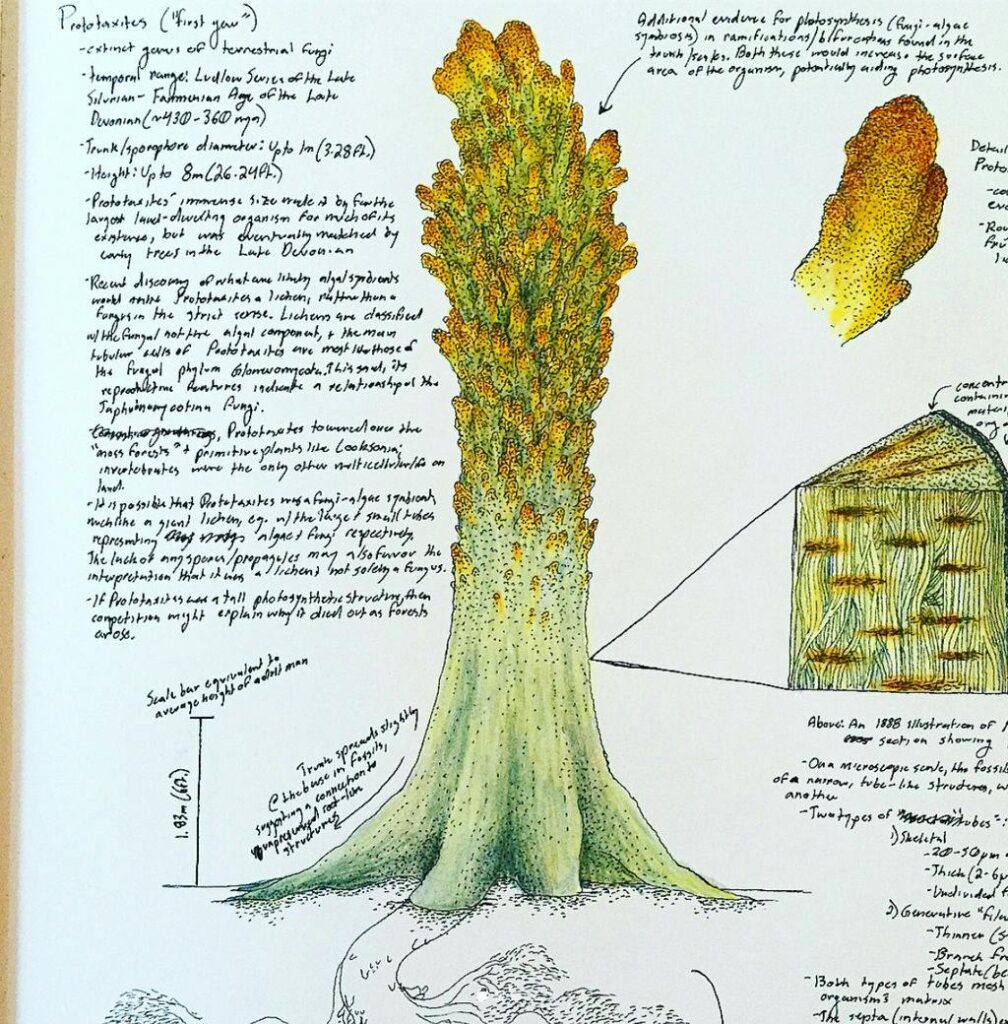
Around 420 million years ago, the tallest plants on land stood only a few feet high. Yet Prototaxites towered up to 8 meters tall and 3 meters wide. These massive spires dominated the sparse Devonian landscapes, poking up from marshy wetlands. As geophysicist Kevin Boyce described, “A 6-metre fungus would be odd enough in the modern world, but at least we are used to trees quite a bit bigger.”
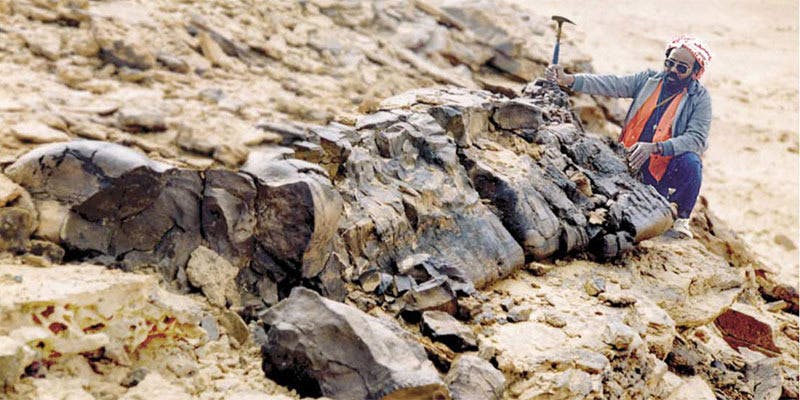
When the first Prototaxites fossils were unearthed in the 1800s, scientists were baffled. Charles Dawson, the Canadian paleontologist who discovered them in 1859, thought they were ancient tree stumps. But as more specimens emerged worldwide, confusion mounted. What exactly was this giant organism?
Debates Raged for Over a Century
Prototaxites confounded experts for over 130 years. As the University of Chicago summed up: “For the next 130 years, debate raged. Some scientists called Prototaxites a lichen, others a fungus, and still others clung to the notion that it was some kind of tree.” Analyses of the fossils were inconclusive.
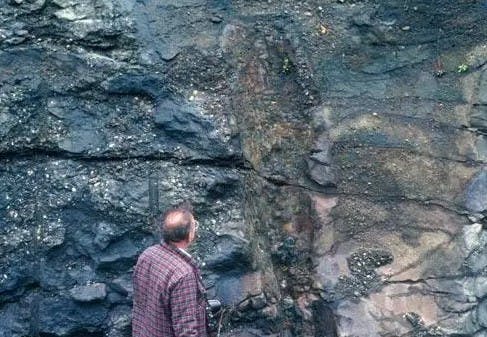
The mystery deepened when Francis Hueber of the Smithsonian Institution revived the fungus theory in 2001. He closely examined Prototaxites’ internal structure under the microscope, noting its intricate filament-like composition. This supported the fungus interpretation, yet many remained skeptical that any fungus could grow so massive.
The Smoking Gun Evidence
In 2007, paleontologist C. Kevin Boyce finally uncovered evidence conclusively identifying Prototaxites as a fungus. Boyce compared carbon isotopes within 400 million-year-old fossils and contemporary plants. He discovered Prototaxites had a much wider carbon ratio, indicating it consumed diverse food sources like a fungus – not just photosynthesized carbon dioxide like a plant.
As Boyce summed up: “A 20-foot-tall fungus doesn’t make any sense. But here’s the fossil.”
Though exact reasons for Prototaxites’ hugeness remain uncertain, its fungal identity has been established. Armed with this knowledge, scientists can now paint a clearer picture of primordial ecosystems. As Boyce explained, “This gives us an overview of ecosystems not getting preserved otherwise.”
Reconstructing an Alien World
Knowing Prototaxites was a mushroom helps fill in the environmental backdrop of its era. As Hotton of the Smithsonian noted, “This fossil would have been all the more striking in such a diminutive landscape.”
In the sparse Paleozoic terrain, dominated by only millipedes and wingless insects, towering mushroom trunks must have looked otherworldly. Prototaxites was one of the first complex terrestrial organisms to exploit wide open ecological space and expand to such grand proportions.
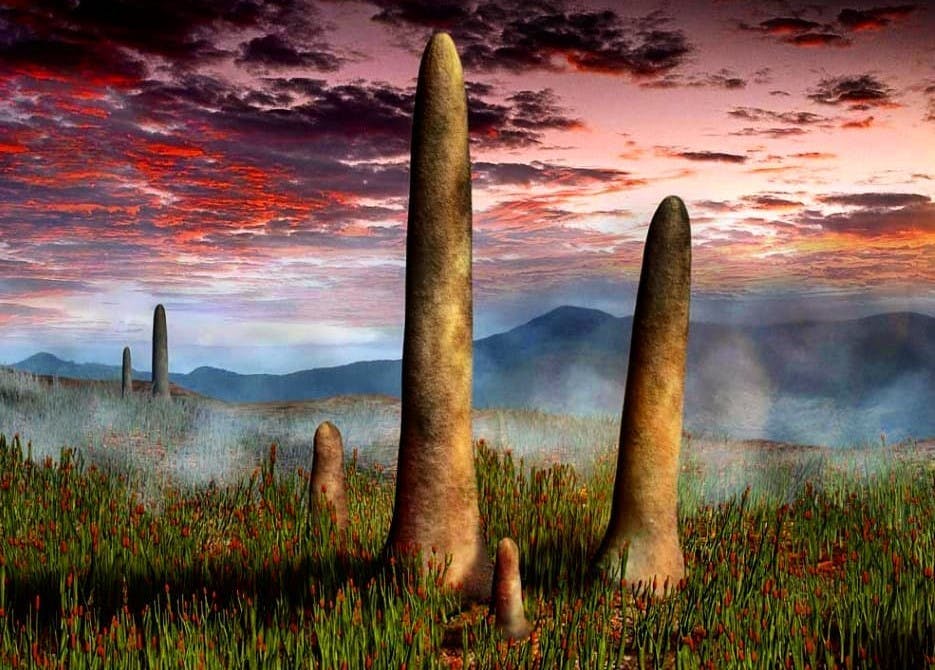
Now dubbed the “Godzilla of Fungi”, Prototaxites offers a window into a land before backboned animals, when giant mushrooms could thrive. Though the king of fungal spires perished long ago, it left an enduring imprint on the fossil record. In Boyce’s words, “That world was a very strange place.” Yet piecing together its mysterious past enriches our understanding of life’s early forays onto land.
📈😲Additional Facts
10 Million spores
A single fungi can spread over 10 Million spores a day. A fungi spore is a reproductive structure that is produced by fungi as part of their life cycle for reproduction and dissemination.
2,200 Acres
The largest organism on Earth is a fungus – a honey fungus in Oregon that covers 2,200 acres.
148,000
species of fungi have been identified. It is estimated that there may be as many as 3.8 Million species of fungi on Earth.