Astrophysicists have long known that the universe is full of surprises, but even our own Solar System can make our head spin. It turns out that the center of the Solar System is not the Sun and so Jupiter doesn’t orbit the Sun. In fact, none of the planets revolve around the Sun. They revolve around the Barycenter.
The Barycenter
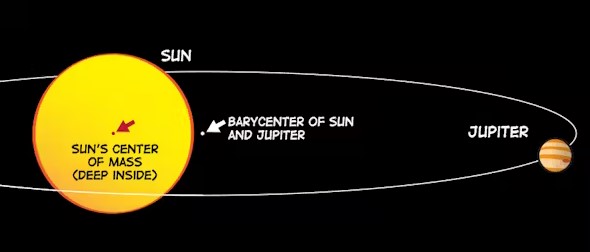
According to NASA, the true center of mass of the solar system is a point called the Barycenter, where the gravitational pull of the planets and the Sun balances each other out. It’s a complex dance that only recently we’re starting to understand.
Jupiter, the largest planet and the Sun have a proportional relationship based on their distance and mass. The Sun’s mass is so large that Jupiter’s gravitational pull on the Sun is only a minuscule fraction of the Sun’s pull on Jupiter. It takes Jupiter 11.8 Earth years to complete a single orbit, and interestingly enough, the Sun takes the same amount of time to travel around the barycenter.
Our Spinning Sun
Our star spins millions of miles outside of the barycenter. Sometimes the Sun goes over the barycenter bringing the center of mass of the Solar System inside the Sun, and sometimes it’s outside the Sun. If you saw a sped up movie of the Sun from the top down, you would see the Sun rotating around an invisible spot; the barycenter. So rarely does the Solar System orbit the actual Sun.
Any two objects with significant mass in space have a barycenter they revolve around. The larger an object is in proportion to the smaller object, the more likely the barycenter will be located inside the larger object. The Earth and the Moon have a barycenter as well, but because the Earth is 81 times as massive (in density and gravity) than the Moon, the barycenter is located inside of Earth. Even so, the Earth does have a slight wobble because of the Moon’s mass.
Jupiter and the Sun
So are we being nitpicky about this? Yes… and no. The Sun contains 99.9% of the mass of the Solar System so technically the planets and everything in the Solar System do orbit the Sun. But with Jupiter making more than twice the mass of all of the rest of the matter in the Solar System, saying that Jupiter doesn’t orbit the Sun is technically correct.